Tailored hormone therapy for real results.
Bioidentical hormone therapy, testosterone replacement, and pellet therapy for men and women — evaluated, dosed, and monitored by a physician. No hype, no scare tactics, no mail-order scripts.
A real doctor, start to finish
Most hormone marketing is all upside. We practice differently: a physician (DO) reviews your symptoms and labs, confirms whether you actually have a deficiency, explains the benefits and the risks in plain language, and monitors you over time — under one roof, across our Kent and Renton clinics.
When hormones are the missing piece
Women
Hot flashes, night sweats, broken sleep, mood changes, vaginal dryness, low libido, and brain fog around perimenopause and menopause — when symptoms pair with confirmed low levels.
Men
Fatigue, low sex drive, erectile changes, loss of muscle and strength, weight gain, and low mood — when labs confirm low testosterone.
Not everyone is a candidate — and more hormone isn’t better when your levels are already normal.
More hormone isn’t more benefit
Hormone therapy helps most when there’s a true deficiency plus symptoms. If your levels are already healthy, adding more usually won’t make you feel better — and it can add risk. We dose toward normal, physiologic ranges, guided by your labs.
Safety you can see, in writing
Monitoring is the part of hormone therapy that keeps it safe — so here’s the schedule we actually follow, before you ever start. It’s individualized, but this is the baseline rhythm.
Men (testosterone)
- Baseline: testosterone (two morning draws), CBC/hematocrit, PSA, metabolic panel
- 6–8 weeks: re-check testosterone & hematocrit, adjust dose, review symptoms
- 6 & 12 months, then yearly: testosterone, hematocrit, PSA, symptoms
Women (estrogen ± testosterone)
- Baseline: symptoms, relevant hormone levels, age-appropriate screening; confirm progesterone need
- 4–6 weeks: symptom & level check, assess for side effects
- Each re-dose & yearly: symptoms, levels as indicated, side-effect review
Notice who actually talks about safety
Here’s a quick test for any hormone provider. A lot of marketing — especially med-spa and online-only services — never mentions side effects, contraindications, or monitoring at all. The pitch is all upside.
A clinic that won’t tell you the risks isn’t sparing you worry; it’s skipping the part that keeps you safe. Everything on this page — who shouldn’t take it, what can go wrong, what we monitor — is the conversation a responsible provider should have with you before the first dose. If a clinic you’re considering doesn’t, that tells you something.
Straight answers
Will hormones make me feel better even if my levels are normal?
Usually not. The benefit comes from correcting a true deficiency. Adding hormone when your levels are already healthy tends not to help and can add risk — which is why we test first.
Are hormone pellets FDA-approved?
Some testosterone products are FDA-approved; many compounded pellets are not. We tell you honestly which applies to your therapy before you start.
What are the risks?
They’re real and not all minor. In women, excess testosterone can cause changes that may be permanent; in men it affects red blood cell counts and fertility. We review the full list and monitor you throughout.
Who isn’t a candidate?
People with hormone-sensitive cancers, certain clotting or liver conditions, men trying to conceive, and anyone unwilling to do follow-up labs, among others. We screen for this at your consultation.
How often will I need labs?
Baseline before you start, a re-check around 6–8 weeks, then periodic monitoring and a yearly review.
How It Works
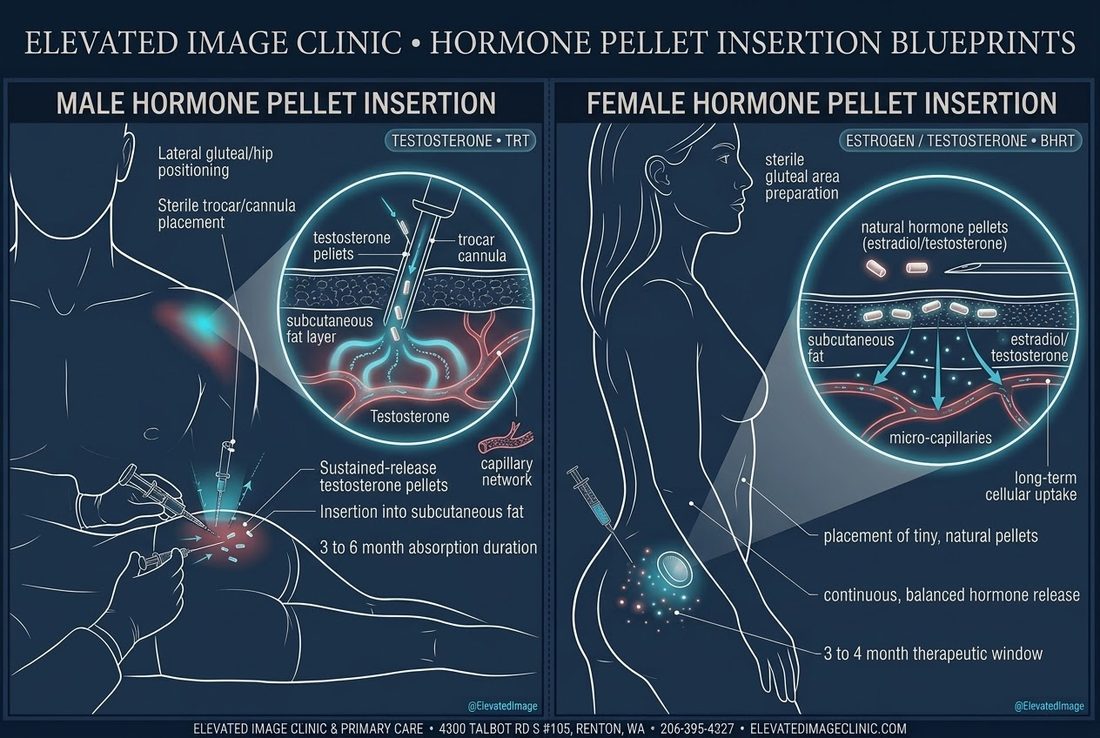
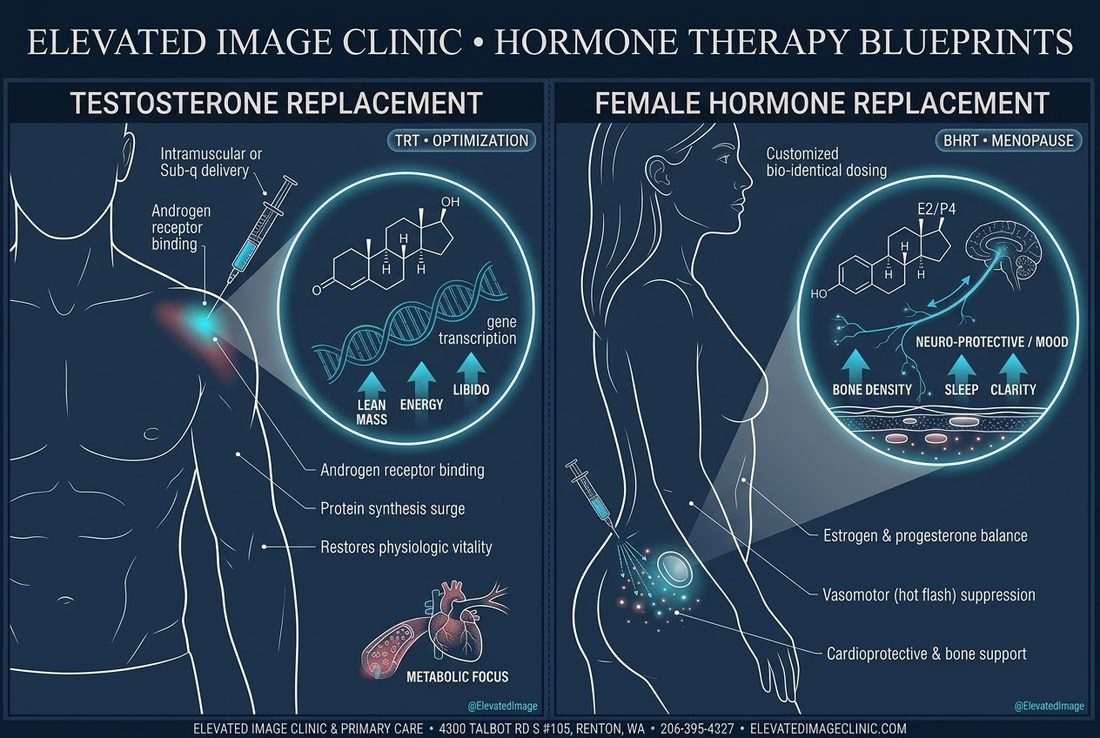
Two sides of the same science — how pellet therapy is placed, and how replacement hormones actually work in the body. These are educational diagrams; your protocol is individualized after a physician reviews your labs and symptoms.
Find out if hormone therapy is right for you
Start with a consultation and baseline lab panel to see what your levels actually are — no pressure, no pre-written answer.
📞 (206) 395-4748 · Call or book online to schedule.
Backed by the evidence
Which symptoms improve — and for how many people?
Low hormones show up in predictable ways. Below are the symptoms we see most often and how often each improves when a true deficiency is confirmed on labs and treated properly — with the research behind each figure. These are study averages, not guarantees; your results depend on your biology, your starting levels, and staying with monitoring.
Most common signs of low hormones
Women (perimenopause / menopause — low estrogen ± testosterone): hot flashes & night sweats, vaginal dryness or painful sex, broken sleep, mood swings or irritability, low libido, fatigue, and “brain fog.”
Men (low testosterone): low sex drive, fatigue and low energy, weaker erections, loss of muscle with easier weight gain, low or flat mood, poor focus, and poor sleep.
| Symptom | Typical improvement (share of patients) |
|---|---|
| Women | |
| Hot flashes & night sweats | ~75% fewer on average (strongest evidence)1 |
| Vaginal dryness / painful sex | Most women improve — ~80–90% with local estrogen2 |
| Disrupted sleep | Roughly half to two-thirds (often as night sweats settle) |
| Mood swings / irritability | Roughly 50–60% |
| Men | |
| Low libido / sex drive | Most men — ~60–70%3 |
| Erectile function | About 40–60% (may need added treatment)3 |
| Low / flat mood | Roughly 50–60%3 |
| Energy / fatigue | Variable — the least consistent benefit3 |
| Muscle, strength & body composition | Measurable gains in most over 3–6 months |
References
- Hot flashes / night sweats: MacLennan AH, et al. Oral oestrogen and combined oestrogen/progestogen therapy versus placebo for hot flushes. Cochrane Database Syst Rev. 2004;(4):CD002978 — ~75% fewer weekly hot flushes vs placebo (95% CI 64–82%). Cochrane review
- Vaginal dryness / GSM: The 2020 genitourinary syndrome of menopause position statement of The North American Menopause Society. Menopause. 2020;27(9):976–992 — low-dose vaginal estrogen effectively relieves moderate-to-severe symptoms in most women. DOI
- Men (libido, erectile function, mood): Snyder PJ, et al. Effects of Testosterone Treatment in Older Men. N Engl J Med. 2016;374(7):611–624 — significant gains in sexual desire, activity and erectile function and modest mood benefit; vitality/energy benefit was limited. DOI
Please read: Educational information only — not medical advice or a promise of results. Percentages are clinical estimates synthesized from the studies above and typical treatment response, and vary by study, dose, and individual. Benefits build over weeks to months and depend on ongoing lab monitoring; not everyone responds, and hormone therapy carries risks and isn’t right for everyone — we review your history, labs, and options with you first.